 SOFT
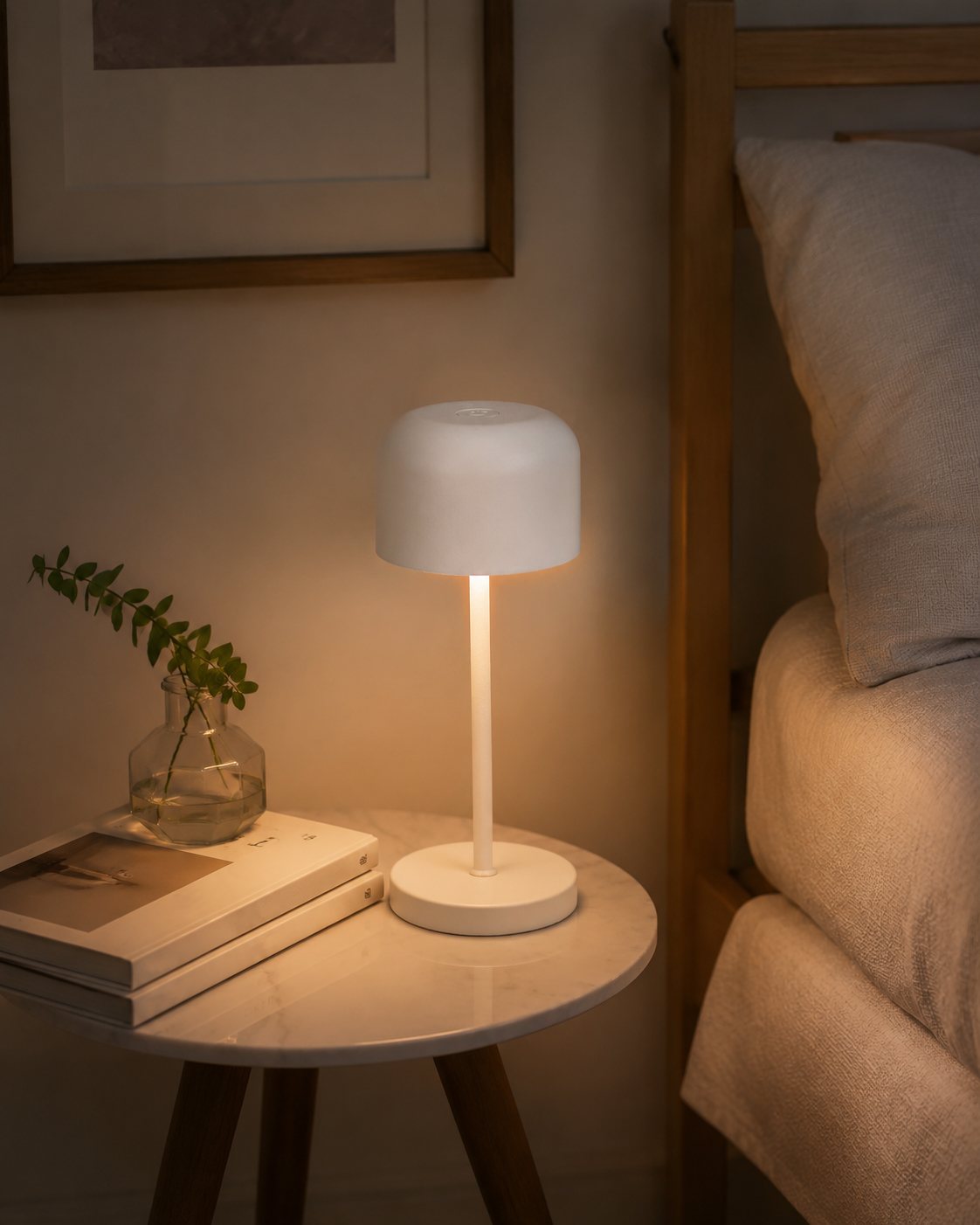
Flicker is the specification nobody puts on a purchase order and everybody notices at 11 p.m. — reading under a lamp that pulses, or filming a hotel room and watching bands crawl across the screen. 'Flicker-free' has no legal definition, which is exactly why buyers need to be specific about it.
- What does 'flicker-free' actually mean?
- Why it matters more in reading lamps than anywhere else
- The three numbers to put on your specification
- Where flicker comes from: the driver, not the LED
- The dimmed state is the hard part
- The specification sheet, line by line
- How to test it in thirty seconds (and properly)
- What our own range looks like
- The one-sentence version
What does 'flicker-free' actually mean?
Short answer: it is a marketing term, not a standard. What matters is two measured numbers — the depth of the light modulation (percent flicker) and how fast it repeats (flicker frequency). A lamp whose output dips 5% at a few kilohertz is effectively flicker-free to a human eye. A lamp whose output dips 40% a hundred times a second is not, even if the box says 'flicker free'.
The practical buying translation: ask for percent flicker below 5–10% and flicker frequency well above the range the eye can follow (3 kHz or higher, or a genuinely constant DC output), measured at full output and at each dimming step. IEEE 1789, the reference most lighting engineers use, plots modulation depth against frequency and marks the regions considered no-risk and low-risk — a useful frame, but the number on your specification sheet is what you can actually inspect against at the factory. The technical background to colour quality sits in our colour temperature guide.
Why it matters more in reading lamps than anywhere else
Flicker complaints scale with proximity and duration. A ceiling panel pulsing at 100 Hz is irritating; the same modulation in a bedside lamp 40 cm from a guest's eyes, held there for an hour of reading, is what produces the 'the light gave me a headache' review that a hotel cannot answer. Reading distance is the harshest test in residential lighting, and reading is precisely what table and bedside lamps are bought for.
The second exposure is cameras. Phones now have electronic shutters that sample faster than the flicker cycle, which is why a guest filming a room can see rolling bands on video that nobody noticed in person. For hospitality buyers this is a brand problem rather than a technical one: the property looks cheap in a clip that a generator produced for free. Both exposures point at the same fix, and it is decided in the driver, not in the finish.
The three numbers to put on your specification
Percent flicker (also called modulation depth) is the swing between maximum and minimum output: (max − min) ÷ (max + min) × 100. It is the number that decides whether the eye registers the light as steady. A well-designed constant-current driver sits in the low single digits; a cheap capacitor-fed design can reach 30–50% at 100 Hz.
Flicker frequency is how many times per second that swing repeats. Mains-driven ripple lands at twice the supply frequency — 100 Hz in 50 Hz markets, 120 Hz in 60 Hz markets — which is inside the range that eyes and camera shutters both notice. Raising the frequency by an order of magnitude (to a few kilohertz) moves the light out of the perceptible band even if the modulation depth is not perfect. Flicker index, the third metric, weights the time spent at each level and is what laboratories report alongside the other two; for purchasing purposes percent flicker plus frequency is enough to write a testable requirement.
The trap is that these numbers are usually quoted only at full brightness. Buyers who care about flicker should require them at 100%, 50% and the lowest usable step, because that is where the divergence appears.
Where flicker comes from: the driver, not the LED
An LED is a diode: give it steady current and it emits steady light. Everything that pulses happens in the driver that feeds it. Two design choices dominate. First, how the mains is converted — a proper constant-current driver with adequate smoothing capacitance holds the output flat through the mains cycle, while a cost-reduced driver lets the 100 Hz ripple pass straight through to the LED. The capacitor is one of the cheapest components to remove and one of the most expensive to remove badly.
Second, how dimming is implemented. Reducing current in steps (constant-current dimming) keeps the light steady at every level. Pulse-width modulation switches the LED fully on and off very fast and relies on persistence of vision — fine at high frequencies, visibly pulsing if the switching rate is low. Phase-cut dimming on an E27 lamp inherits the quality of whichever dimmer is on the wall, which is why retrofit-style families should specify dimmer compatibility rather than assume it. None of this is visible in a product photo, and all of it is settled before the sample ships.
The dimmed state is the hard part
Almost every flicker complaint we see traced back to factory samples concerns the bottom of the dimming range, not the top. Drivers that hold perfectly steady at 100% can start skipping cycles at 15% to keep the low end stable, which reads as a shimmer exactly when the guest is trying to wind down. This is why the requirement belongs in the sample protocol as a separate line item: measure at each step, not once.
It is also why we treat dimming behaviour and flicker behaviour as one conversation with the driver supplier rather than two. The bedside dimming guide covers the step patterns to ask for; add the flicker figures for those same steps and the specification is complete. Guests cannot separate 'the dimming feels wrong' from 'the light shimmers' — it arrives as one complaint about the lamp.
The specification sheet, line by line
This is the version we recommend buyers paste into a quotation request. Each line is testable, which is the point — an untestable requirement is a wish.
| Parameter | What to write | Target | How to verify |
|---|---|---|---|
| Percent flicker | Modulation depth at 100 / 50 / 15% output | < 5–10% at every step | Flicker meter, or high-frame-rate camera at the sample round |
| Flicker frequency | Ripple frequency of the driver output | ≥ 3 kHz, or constant DC | Driver datasheet plus measurement |
| Dimming method | Constant-current reduction preferred | No low-frequency PWM at dimmed steps | Slow-motion video of the diffuser |
| Driver class | Constant-current, branded or specified | Smoothing capacitance stated | Driver marking and datasheet in the quotation |
| CRI | Colour rendering of the LED package | > 90, 95+ on reading families | LED bin certificate per production lot |
| Dimming compatibility | Dimmer types supported (for E27 models) | Named dimmer list tested | Bench test with the buyer's own dimmer |
How to test it in thirty seconds (and properly)
The field test costs nothing: point a phone camera at the lit diffuser, switch to slow-motion or a manual high shutter speed, and watch the screen. Visible bands or a strobing pattern mean the modulation is deep enough for the camera to catch — which on a reading lamp is a fail, whatever the datasheet says. Repeat at the lowest dimming step, where the problem usually lives. This is exactly what a guest with a phone will do, so it is a fair test of the experience.
The proper test is a flicker meter in a dark room at each dimming step, with the readings recorded against the golden sample. Put it on the same page as your finish, stability and control checks — the sample confirmation protocol is the right place for it — and reference the numbers on the purchase order so that the incoming inspection has something to compare production against. A flicker requirement that exists only in an email has a half-life of about one production run.
What our own range looks like
Our table and bedside range has 61 models, with lamp-level power from 0.5 W to 20 W and a median of 4.5 W — the low-output class where a reading lamp sits and where driver quality is most visible, because at 4.5 W the LED is running gently and any ripple shows up in the diffuser rather than being washed out by raw output. Colour temperature is deliberately warm-dominant, as the chart below shows: the reading families cluster at 2700–3000 K, because warm light at 40 cm is what the room actually wants in the evening.
That mix is not accidental. Warm, dimmable light is the combination that makes flicker visible, so those are the families where we specify flicker-free driver practice (IEEE 1789 guidance) and high colour rendering, and where the sample round matters most. If you are building a reading or hospitality lamp programme, tell us the market and the dimming requirement and the quotation comes back with the driver class stated — not just 'dimmable'. The full range is on the table lamp page, night lights on the bedside page, and the OEM and ODM page explains how a driver specification becomes a private-label programme.
The one-sentence version
If you remember nothing else: specify percent flicker and flicker frequency at every dimming step, verify them with a camera in the sample round, and put the numbers on the purchase order. Everything else about flicker is explanation.
Quick answers
Is 'flicker-free' a legal or certified term?
No — it is a marketing claim with no binding definition. Ask instead for percent flicker and flicker frequency at each dimming step, expressed as measurable values you can verify against a sample.
What percent flicker is acceptable for a reading lamp?
Below 5–10% at full output and at each dimming step, with flicker frequency at 3 kHz or higher (or a genuinely constant DC output). Anything deeper at 100–120 Hz sits in the range both eyes and phone cameras register.
Why do cheap LED lamps flicker more?
The driver. Adequate smoothing capacitance and constant-current regulation cost money; removing them lets the 100/120 Hz mains ripple pass into the LED. Low-cost phase-cut dimming adds a second source at the dimmed steps.
Do dimmed lamps flicker more than full-brightness ones?
They often do — drivers can drop into cycle-skipping at the bottom of the range to keep the low end stable. This is why the requirement has to be measured at 50% and at the lowest usable step, not only at 100%.
How can I test flicker without a flicker meter?
Point a phone camera at the lit diffuser in slow-motion or with a high manual shutter speed, and repeat at the lowest dimming step. Visible bands or strobing mean the modulation is deep enough to matter. Confirm with a flicker meter at the sample round.
Does flicker affect the LED's lifetime?
Not directly at these modulation depths — the practical cost is comfort and brand perception, not lamp life. The lifetime drivers are thermal design and driver quality, both of which are separate specification lines on the same quotation.