 SOFT
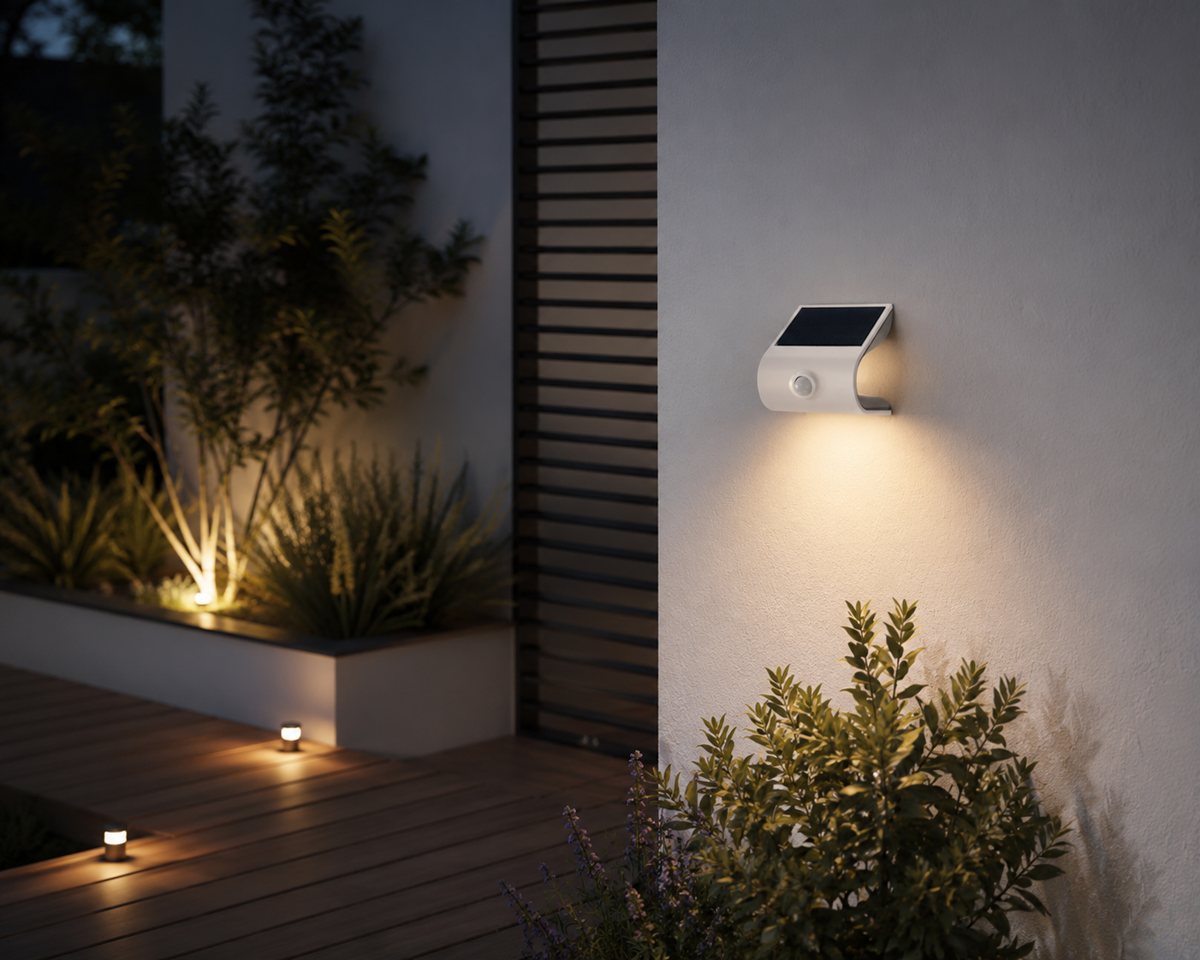
Solar lights live outdoors in every weather and sell on promises — '8 hours of light', 'all-weather', 'no wiring' — that the buyer is the one who has to make true. The difference between a repeat-order product and a returns magnet is decided by a handful of specification lines, all checkable before the container ships.
- What actually decides whether a solar light is good?
- IP rating: match the number to the mounting position
- Battery chemistry: the line that decides the second winter
- Panel and charging: autonomy is designed, not hoped for
- Light output: stop comparing watts, start comparing lumens — and check the colour
- The specification checklist for your first solar order
- How our outdoor range is organised
- Ordering notes: solar products are freight goods
What actually decides whether a solar light is good?
Short answer: the battery, the panel, and the housing — in that order. The LED is the reliable part; at these power levels (our range runs from 1.5 W path markers to 15 W flood-style units) any reasonable LED outlives everything around it. What fails in the field is a battery that stops holding charge in its second winter, a panel shaded by one branch, or a gasket that gives up after a wet season.
So the buyer's checklist is about the system, not the diode: does the battery chemistry suit the destination market's climate, is the IP rating matched to where the fitting actually mounts, does the stated runtime account for shorter winter days, and is the housing material specified rather than implied? None of these are exotic questions — they are just expensive to skip, and the specification sheet below turns them into lines you can put in a purchase order.
IP rating: match the number to the mounting position
Outdoor ranges tend to cluster at two protection levels, and ours is typical of the category: 77 of our 110 outdoor and garden models are IP44 and 33 are IP67. That split is not random — IP44 (splash-proof from any direction) suits wall-mounted fittings under eaves and canopies where rain arrives sideways at worst, while IP67 (dust-tight and immersible) is what ground-level fittings need, because a bollard base sits in soil that holds water for days after rain.
The expensive mistake is buying on a single number. An IP67 path light under a covered porch is over-specified and overpriced; an IP44 marker planted in a flowerbed is a seasonal product that dies at the first week of heavy rain. Write the mounting position into the enquiry — 'in-ground', 'wall under eave', 'post-top' — and let the rating follow from it. The full logic of the ratings is in our IP ratings guide; the short version for solar buyers is that the base and cable entries, not the diffuser, are where water gets in.
Battery chemistry: the line that decides the second winter
Most quality solar lights run lithium-ion packs, and the market has consolidated there for good reason: energy density, flat discharge curves that keep brightness stable through the night, and hundreds of usable cycles. Our own range reflects it — 28 models state lithium-ion packs in the catalogue. Nickel-metal-hydride cells still appear in entry-level products; they tolerate overcharging more gracefully but store less energy per gram and fade in cold weather, which is exactly when solar autonomy is already at its worst.
Two battery questions belong in every quotation. First, cycle life: a pack rated for 500 cycles is roughly two seasons of nightly deep discharge before noticeable fade, and replacement handling (a screw-open compartment versus a sealed unit) decides whether that is a maintenance task or a warranty claim. Second, temperature rating: lithium chemistry needs charging protection below freezing, and a market with cold winters needs that stated, not assumed. This is also where '8 hours of light' claims earn their asterisks — autonomy is a battery specification, not a lighting one.
Panel and charging: autonomy is designed, not hoped for
The panel's job is harder than the LED's: it must harvest enough energy on an overcast November day to deliver the rated hours that same night. Three specification lines cover it. Panel size and type (monocrystalline outperforms polycrystalline in weak light and is worth the premium on anything sold for year-round outdoor use). Placement freedom — a fitting that lets the installer angle the panel toward the sun outperforms a fixed-horizon panel in every garden that has trees. And charge control — overcharge and deep-discharge protection are what keep the battery's cycle-life claim true in the field.
Buyers should also ask how the product behaves after three dark days. A light that drops to a dim mode rather than dying outright keeps the customer experience intact through a bad weather week; a hard cutoff turns a grey spell into a returns wave. None of this shows in the sample photo — it shows in the specification sheet, which is why the sample round exists. The mechanics of that round are the same as for mains products, described in our sample confirmation protocol.
Light output: stop comparing watts, start comparing lumens — and check the colour
Watts in a solar light measure consumption, not output; with battery capacity fixed, a lower-watt LED that is better optically can out-light a higher-watt one. Lumens are the comparable number for path markers and bollards, and the honest ranges are modest — a path light that is pleasant and safe sits far below what a mains floodlight produces, and products claiming floodlight numbers from a post-top solar unit are the first red flag in a supplier conversation.
Colour temperature is where ranges differentiate, and ours runs deliberately warm: among the catalogue-stated models, 3000 K leads (6 models), with 4000 K and 5000 K for utility areas, 2500 K for a softer garden mood — and one 1700 K amber model for insect-friendly and coastal applications. Warm-white garden light is what residential and hospitality buyers keep reordering; cool white photographs better in a web listing and disappoints in a garden, the same pattern our colour temperature guide describes for interiors. The chart below shows the stated-CCT mix across the outdoor range.
The specification checklist for your first solar order
Paste this into the quotation request; each line is testable at the sample round, which is the point.
| Line | What to specify | Why it decides the reorder |
|---|---|---|
| Battery | Chemistry (Li-ion), capacity in mAh, cycle life, replaceable or sealed | The component that fails first — replacement handling decides warranty cost |
| Autonomy | Runtime hours at full and dim mode, after 1 overcast day and after 3 | Marketing claims live here; dim-mode fallback keeps grey weeks from becoming returns |
| Panel | Type (mono/poly), size, fixed or adjustable angle | Weak-light harvesting is what separates seasons of use from one summer |
| Protection | Overcharge and deep-discharge cut-off; low-temp charge lockout for cold markets | Keeps the cycle-life claim true in the field |
| IP rating | Matched to mounting: IP44 under cover, IP67 in-ground | Water enters at bases and cable entries, not diffusers |
| Output | Lumens at 0.5 m, CCT; dim mode level | Watts mislead; warm white is what gets reordered |
| Housing | Material (aluminium / ABS), UV stabilisation, gasket design | UV-yellowing and gasket creep are the visible failures of year two |
How our outdoor range is organised
The catalogue holds 110 outdoor and garden models across five ranges, which is deliberately more structure than a single 'solar lights' folder: solar bollard and path lights (55 models — the volume line), solar mood and portable lights (25), garden and path spotlights (13), outdoor wall lights (11, mains or solar per model), and solar string lights (6). The outdoor overview page lays out all five with their IP ratings and power ranges.
For programme buyers the useful question is which two or three of those ranges a market actually needs — a garden-centre chain and a hospitality buyer will make different cuts from the same 110. That mapping is a conversation, not a filter: send the market, the mounting mix and the price band, and the quotation comes back scoped to what will actually sell through. The OEM and ODM page covers how private label works on top of it, and the factory page shows the lines behind the ranges.
Ordering notes: solar products are freight goods
Two practical differences from indoor lamp orders. First, cube: solar lights are bulky for their value — panels, stakes and diffusers pack air, and the master-carton dimensions matter more to landed cost than the unit price does. The container-math logic in our bulk buying guide applies double here; ask for carton dims and units per carton with every quotation.
Second, seasonality: outdoor solar sells in a narrow window in most markets, so orders front-load into winter production and compete for capacity with everyone else's spring ranges. Framework buyers reserve slots ahead; spot buyers discover lead times in March. Either way, confirm the production window at order stage, not at the point of need — and if the range is working, a repeat order placed before the season is the cheapest capacity money can buy.
Quick answers
How long do solar garden lights actually run at night?
A well-specified unit with a lithium-ion pack runs its rated hours after a normal charging day, and a dim-mode fallback after overcast days. Autonomy is a battery-and-panel specification, so judge it from the spec sheet and the three-dark-days test, not from the box claim.
Is IP44 enough for garden lights, or do I need IP67?
Match the rating to the mounting position: IP44 suits wall-mounted fittings under cover; in-ground and post-top fittings exposed to standing water need IP67. Water enters through bases and cable entries, which is why mounting position decides the rating.
Which battery type should I specify — lithium-ion or NiMH?
Lithium-ion for anything sold as a year-round outdoor product: higher energy density, stable brightness through the night, more cycles. NiMH survives overcharging more gracefully but stores less and fades in cold weather, exactly when autonomy is already worst.
How many lumens should a solar path light produce?
Enough for orientation and ambience, not floodlight numbers — path and bollard markers sit in a modest lumen range by design. Treat claims of floodlight output from a small solar unit as a red flag and ask for lumens at a stated distance instead of watts.
Do solar lights need direct sunlight to charge?
Direct sun charges fastest, but the specification that matters is weak-light harvesting — panel type, size and angle freedom decide how the unit performs on overcast days, which is most days in the markets that buy the most solar lighting.
What is the MOQ for solar garden lights?
Per model and finish, driven by battery pack and panel minimums on custom orders. Send the model list, destination market and target quantity with the enquiry and the quotation returns MOQ, unit pricing and carton specs — typically within one business day.